Overview
We praise Allah and send peace and blessings upon His noble Messenger, his family, and all his companions.
It is a great favor and honor from Allah, Lord of Majesty, that He blessed us with the beautiful gift of Islam and a magnificent way of life for which there is no equal among all the nations of the world. This magnificent guide is with us in the form of the Qur’an. Every Muslim has many obligations toward this divine book, and fulfilling them is a duty — such as believing in it, understanding it, reflecting on its meanings, and spreading its message to the corners of the world. Among these responsibilities, a basic and essential right is to recite it correctly.
Therefore, reading the Qur’an properly is obligatory for every Muslim, as Allah Himself has commanded in the Qur’an:
“And recite the Qur’an with measured recitation.” (Surah Al-Muzzammil)
To recite with tarteel and proper pronunciation, knowledge of Tajweed is necessary — to know where to stretch (madd), where to nasalize (ghunnah), when to hide (ikhfa), when to make clear (izhar), etc.
Allah says in the Qur’an:
“Those to whom We gave the Book, they recite it with its true recitation. They are the ones who believe in it. And whoever disbelieves in it — they are the losers.”
(Surah Al-Baqarah)
This verse tells us that those who recite the Qur’an properly are the true believers, and incorrect recitation can even change meanings. For example, the Arabic word “Qalb” means heart, but if we pronounce the letter Qaaf incorrectly as Kaaf, it becomes “Kalb”, which means dog — a major and serious mistake in the Qur’an’s meaning.
On one occasion, our beloved Prophet Muhammad ﷺ said:
“The best among you are those who learn the Qur’an and teach it to others.”
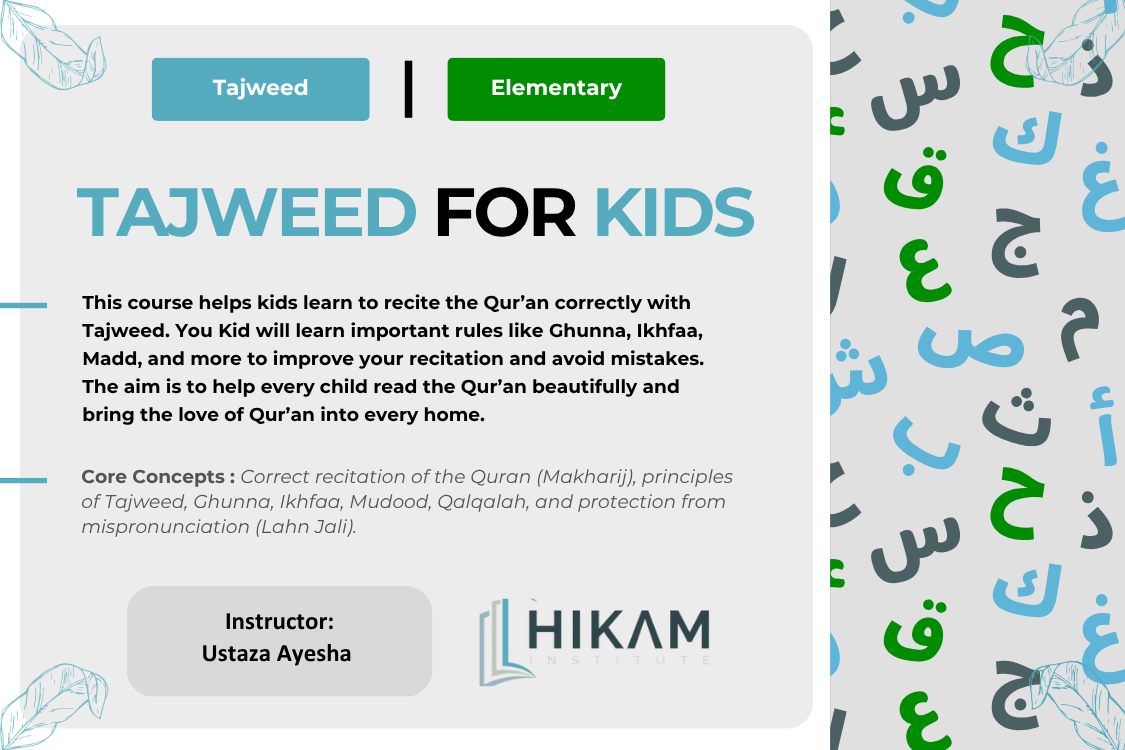
This course has been designed to help children fulfill the right of proper Qur’anic recitation with Tajweed.
Curriculum
- Makharij – Articulation points of Arabic letters
- Rules of Tanween, Noon Saakin, and Meem Saakinah
- Mudood and Qalqalah – Rules of elongation and echoing sounds
- Sifaat – Characteristics of letters
- Tafkheem and Tarqeeq – Heavy and light letters
- Iltifaq-us-Saakinain – Meeting of two sukoon letters
- Idghaam Rules – Merging of letters with and without nasal sound
Rules & Eligibility
Who is Eligible?
This Tajweed course is for children:
-
Who can read the Qur’an by looking (Nazirah).
-
Who recognize Arabic letters and can read full ayahs fluently.
-
Who have access to a smartphone, tablet, or laptop.
-
Who have a stable internet connection.
-
Who know how to use Zoom or Google Meet (or have adult help at home).
Rules and Guidelines
Parent Must Ensure the Following:
General Rules:
- Remain active during classes.
- Show respect to the teacher and other class members.
- Do not interrupt the teacher during class, unless it is very important; questions and answers will be addressed in the last 10 minutes.
- Taking notes in the class will make it easier to remember lessons later.
Attendance guideline:
- Attend class on time; if you are unable to attend, provide advance notice.
- If you accumulate 6 absences in this course, you will be removed from the course.
- Entering class more than 5 minutes late will be considered a delay, and 3 delays will count as one absence.
Note: Attendance is taken very seriously in our institution.
Electronic device guidelines:
- Keep your microphone muted during class unless absolutely necessary.
- Enter the classroom with the same name you used for registration.
- Since the class consists of only women, the teacher may ask you to turn on your camera.
- Be mindful of the privacy of others and yourself. During Class ensure that no men are viewing the screen at any time.
Food and drink guidelines:
Consumption of food and drinks is not permitted during class, except for water.
Communication protocols:
- Ten minutes will be allocated for questions and answers at the end of each class.
- Address the teacher only as “Ustaza Ayesha”, do not use any other terms.
- If the Q&A session extends beyond 10 minutes, you may leave the class with the teacher’s permission.
- If you have a question or concern from the previous week, or if you do not receive an answer during the class, you can ask the teacher on their number or group.
- Keep your questions brief and to the point, as the time allocated for the Q&A session is limited.
Coordinators:
Ka’ab ibn Talha – 0091 9650498479 (10:00 AM – 08:00 PM IST)
The Coordinator will make every effort to respond to you as soon as possible. However, depending on the nature of the question and time constraints, there may be a delay in the response.
Course Assessment:
- Final Exam: 60 marks (Oral exam)
- Various Activities: 40 marks (Class attendance, attention and participation, class homework, and various assignments)
- To pass the course and receive the certificate, you must obtain at least 50 out of 100 marks.
Course duration:
Total duration: 2 months.
Total weeks: 8 weeks.
Total sessions: 16 sessions.
Days: Saturday & Sunday
Time (IST): 06:30 PM-07:30 PM (IST)
Language of class: Urdu language.
Starting Date: 19th July 2025
Course Fees
Admission Fee (One-Time Payment): 350/- Indian Rupees
- Note: Scholarships are available for those in genuine financial need. If you require assistance, please reach out to the administrator for further guidance. (Covered by Hikam Institute’s Charitable Trust)
Kindly contact the administrator to facilitate the payment of the fee: +919650498479
Do Not Join If:
Co-Ordinator
Instructor