
Overview
In the Name of Allah the Most Gracious the Most Merciful,
Dear Brothers and Sisters in Islam,
As we are all aware, after the Qur’an, nothing holds greater importance than the Sunnah of our beloved Prophet (peace and blessings be upon him). His actions, sayings, and approvals of others’ deeds provide essential guidance for every Muslim worldwide. A Muslim cannot genuinely and wholeheartedly practice his or her faith without believing in the Hadith just as firmly as he or she believes in the Qur’an.
Hadith is the second most critical source of Islamic creed, traditions, and jurisprudence. It represents Al-Waḥyul Khafī—the subtle form of revelation that was revealed to the Prophet’s heart to interpret and explain the Holy Qur’an. Our beloved Prophet (peace and blessings be upon him) never spoke from his own desires but was guided entirely by divine revelation. Allah Almighty states clearly:
“By the stars when they fade away!
Your fellow man (Muḥammad ﷺ) is neither misguided nor astray.
Nor does he speak of his own whims.
It is only a revelation sent down to him.”
(Qur’an 53:2-4)
Thus, it is mandatory for everyone who desires to practice Islam to adhere strictly to his commands and emulate his example. This is the singular path to attaining success both in this world and in the Hereafter. Allah ‘Azza wa Jalla commands:
“Whatever the Messenger gives you, take it.
And whatever he forbids you from, leave it.”
(Qur’an 59:7)
And He further emphasizes:
“It is not for a believing man or woman—when Allah and His Messenger decree a matter—to have any other choice in that matter.
Indeed, whoever disobeys Allah and His Messenger has clearly gone far astray.”
(Qur’an 33:36)
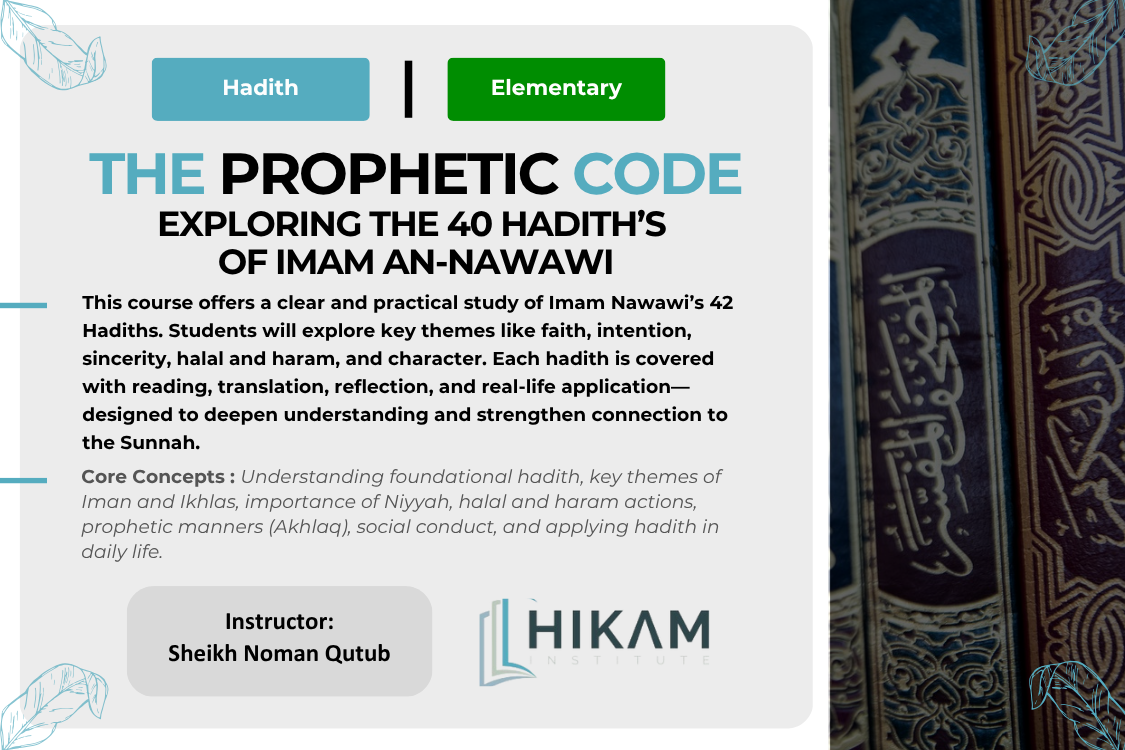
Keeping the above in mind, we are pleased to introduce a new course focused on understanding the Sunnah. In this course, we will read and reflect upon a highly respected book by the esteemed Islamic scholar Imam Nawawi—studying and pondering 42 hadiths over three months.
These hadiths cover essential topics related to Islamic creed, traditions, and philosophy. Unlike other similar collections which often specialize in a single major theme, this book addresses various core concepts of Islamic belief, making it highly esteemed among scholars and students of knowledge.
Let us embark on this enlightening journey together, striving for closeness to the Prophet (peace and blessings be upon him) and expressing our love for him, with the ultimate aspiration of meeting him in Jannah.
Curriculum
This three-month course is structured around the study of the 42 hadiths compiled by Imam Nawawi. Each week, we will cover approximately three to four hadiths, dedicating time to reading, translation, contextual understanding, and reflection. The curriculum includes discussions on key themes such as faith (iman), intention (niyyah), sincerity (ikhlas), lawful and unlawful acts (halal and haram), manners and ethics (akhlaq), and social conduct. Practical examples and brief commentary will be provided to help students relate the teachings to their daily lives. The course will be delivered in a manner accessible to students of all levels, aiming to foster not only knowledge but also love and reverence for the Sunnah.
Rules & Eligibility
Who is Eligible?
Any ordinary Muslim woman or man can participate in the course under the following conditions:
- They should have a digital device such as a smartphone or laptop with a good internet connection.
- They should be familiar with using the internet, know how to join platforms like Zoom or Google Meet and know how to turn on/off their microphone and video.
- Otherwise, they should have assistance to fulfill the above requirements.
- They commit to attending two classes weekly, including making class notes, participating in classes, and taking exams.
- Enrollment in the course should be pursued with the sincere intention of completion, rather than for recreational or other purposes.
- They must have a basic understanding of everyday spoken Urdu.
- They must make notes in their own preffered language.
Rules and Guidelines
General Rules:
- To be active during classes and maintain decorum.
- To be respectful of the sheikh and other members of the group.
- Refrain from personal quarrels, disputes, or comments during class.
- Interruptions should be avoided except for urgent matters; questions and answers will be addressed in the last 10 minutes of class.
- If you have difficulty understanding any of the points mentioned, please refrain from arguing. Instead, request a personal session with the Sheikh to clarify your doubts.
- Taking notes during class is mandatory.
Attendance guideline:
- Be present in class on time. In case of absence, submit a prior request for leave.
- If you have 12 consecutive absences in this course or are absent for 6 consecutive days, you will be expelled from the course.
- A delay exceeding 5 minutes after the class has commenced will be recorded, with three such delays counting as one absence.
Note: Attendance is considered a critical aspect of academic commitment at our institution.
Electronic device guideline:
- Microphones must remain muted during class unless activation is necessary for participation.
- Enter the classroom using the name with which you registered.
Food and drink guideline:
Consumption of food and drinks is not permitted during class, except for water.
DO NOT JOIN. —– IF
- If you are busy and can’t attend regularly.
- If you are not serious about completing the course.
- If you are just coming for a trial.
- If you can’t attend weekly tests and complete assignments.
- If you can’t make notes.
- If you don’t have a proper internet connection and device.
Communication protocols:
- The teacher should be addressed only as ‘Sheikh.’ Do not use any other titles such as Teacher, Brother, Janab, Sir, etc.
- At the end of every class 10 minutes will be allocated for questions and answers can be submitted either by typing in the chat box or by speaking.
- If the Q&A session exceeds 10 minutes, you may request permission from the instructor to leave the class.
- If you have any questions or concerns from the previous week, or if your question remains unanswered during class, you may send a message to the following number or ask the teacher directly with their permission.
- Questions should be brief and accurate since the time for the Q&A session is limited.
Coordinators:
Ka’ab ibn Talha – 0091 9650498479
Timings: All days of the week (10:00 AM – 08:00 PM IST)
The Coordinator will make every effort to respond to you as soon as possible. However, depending on the nature of the question and time constraints, there may be a delay in the response.
Course Assessment:
- FINAL EXAM: 50 marks, (it may include multiple-choice questions or short-answer questions covering the entire course curriculum taught in class).
- VARIOUS ACTIVITIES: 50 marks, (attendance, participation, attention in class, completion of homework, and various assignments).
- To pass the course and obtain the certificate, it is mandatory to score a minimum of 60 out of 100.
Course duration:
Total duration: 3 months.
Total weeks: 14 weeks.
Total sessions: 40 sessions.
Days: Monday, Tuesday & Wednesday
Time (IST): 04:00 PM – 05:00 PM (IST)
Language of class: Urdu language.
Starting Date: 4th August 2025
Required texts and resources:
There is no textbook required as such, however, sometimes sheikh might ask to read specific articles.
Notes are very important during class; this is the only source for exam preparation.
Course Fees
This course is absolutely free!
Instructor

Sheikh Noman Qutub
Sheikh is the founder of Hikam Institute. He was born in New Delhi, India, and received his education from esteemed Islamic scholars in India. He obtained his primary education from the renowned institution "Jamiatu-Falah" in the northern part of India. Later, he embarked on a journey of learning as a student of Islamic jurisprudence at the prestigious "Imam Muhammad bin Saud Islamic University, Riyadh" where he also earned a degree in Islamic law. Sheikh has a particular interest in Islamic jurisprudence and Arabic language education, with over five years of teaching experience in these subjects. Furthermore, he has been involved in the establishment of educational institutions and schools across various parts of India. He provides consultancy services in curriculum development, educational material creation, Thesis writing, Dawah center management, and other educational initiatives. Sheikh is an orator along with expertise in addressing various topics of current affairs and nurturing the mental and spiritual growth of young individuals. He is a professional preacher and educator, conducting workshops and individual and family counseling sessions both online and offline for personal development.
Email address: Noman@mail.hikam.institute
Time Zone: Makkah Standard Time