
Overview
Praise be to Allah, and may peace and blessings be upon the Messenger of Allah, his family, his companions, and those who follow him.
The Arabic language holds a special place because it is the language of the Holy Qur’an, the eternal book revealed by Allah. Learning Arabic is essential for every Muslim as it helps them understand the Qur’an and properly perform religious duties. Here are key points that highlight the importance of learning Arabic:
- Language of the Qur’an: Arabic is the language in which the Qur’an was revealed. Allah chose Arabic for His final and most important message to humanity. Understanding Arabic allows you to connect deeply with the words of Allah.
- Foundation of Knowledge: Arabic is the basis for understanding all Islamic sciences. Scholars agree that knowing Arabic is crucial for anyone who wants to study Islam deeply.
- Spiritual and Cultural Significance: Arabic is not just a language but a part of Muslims’ spiritual and cultural identity. It carries the essence of Islamic heritage and civilisation.
- Religious Duty: Many acts of worship in Islam, such as prayers and recitations, are performed in Arabic. Learning the language helps in performing these acts correctly and understanding their meanings.
- Broad and Expressive: Arabic is known for its richness and precision in expressing complex and profound meanings, making it ideal for conveying the teachings of Islam.
- Rewarding: Teaching and learning Arabic are highly rewarding acts. By learning Arabic, you can help spread Islamic knowledge and understanding.
- Essential for Understanding Sharia: Arabic is necessary to understand Islamic law and principles. The deeper you understand Arabic, the better you can comprehend the teachings of Islam.
In summary, learning Arabic is not just about acquiring a new language but about connecting with your faith, understanding the Qur’an, and performing your religious duties effectively. It enriches your spiritual life and strengthens your Islamic identity. Start learning Arabic today to unlock these profound benefits!
Course Overview:
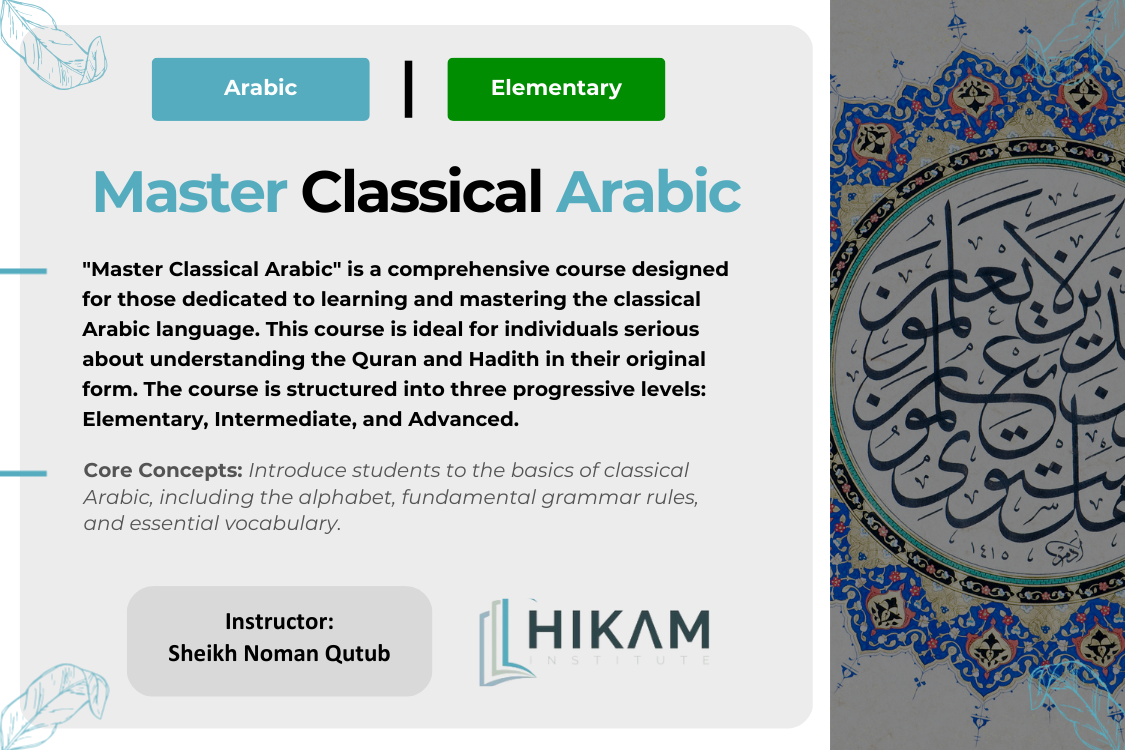
“Master Classical Arabic” is a comprehensive course designed for those who are dedicated to learning and mastering the classical Arabic language. This course is ideal for individuals who are serious about understanding the Quran and Hadith in their original form. The course is structured into three progressive levels: Elementary, Intermediate, and Advanced.
Curriculum
Elementary Level:
- Learn the Arabic Alphabet and Pronunciation and understand and the Arabic letters correctly.
- Master Basic Grammar and form simple sentences by using basic grammar rules.
- Build Foundational Vocabulary and recognize and use common Arabic words and phrases.
- Introduction to Quranic Phrases: Understand basic phrases from the Quran.
Intermediate Level:
- Advance Your Grammar Skills and construct and understand more complex sentences.
- Expand Your Vocabulary: Learn and use more words, especially those found in the Quran and Hadith.
- Improve Reading and Writing: Read and write intermediate-level Arabic texts.
- Analyze Quranic Verses and Hadiths: Begin to understand and interpret simple Quranic verses and Hadiths.
Advanced Level:
- Master Complex Grammar and use advanced grammar rules to understand and form complex sentences.
- Develop a Rich Vocabulary: Use an extensive range of Arabic words confidently.
- Expert Reading and Writing: Read and write advanced Arabic texts fluently.
- In-Depth Analysis and Interpretation: Analyze and interpret Quranic verses and Hadiths in detail.
Translate and Comment:
- Translate and provide commentary on Quranic verses and Hadiths.
By the end of this course, you will be able to read, understand, and appreciate the Quran and Hadith in their original Arabic language.
Rules & Eligibility
Who is Eligible?
Any ordinary Muslim woman can participate in the course under the following conditions:
- They should have a digital device such as a smartphone or laptop with a good internet connection.
- They should be familiar with using the internet, know how to join platforms like Zoom or Google Meet and know how to turn on/off their microphone and video.
- Otherwise, they should have assistance to fulfill the above requirements.
- They commit to attending three classes weekly, including making class notes, participating in classes, and taking exams.
- Enrollment in the course should be pursued with the sincere intention of completion, rather than for recreational or other purposes.
- They must have a basic understanding of everyday spoken Urdu.
Rules and Guidelines
General Rules:
- To be active during classes and maintain decorum.
- To be respectful of the Sheikh and other members of the group.
- Refrain from personal quarrels, disputes, or comments during class.
- Interruptions should be avoided except for urgent matters; questions and answers will be addressed in the last 10 minutes of class.
- If you have difficulty understanding any of the points mentioned, please refrain from arguing. Instead, request a personal session with the Sheikh to clarify your doubts.
- Taking notes during class is mandatory.
Attendance guideline:
- Be present in class on time. In case of absence, submit a prior request for leave.
- If you have 15 consecutive absences in this course or are absent for 6 consecutive days, you will be expelled from the course.
- A delay exceeding 5 minutes after the class has commenced will be recorded, with three such delays counting as one absence.
Note: Attendance is considered a critical aspect of academic commitment at our institution.
Electronic device guideline:
- Microphones must remain muted during class unless activation is necessary for participation.
- Enter the classroom using the name with which you registered.
Food and drink guideline:
Consumption of food and drinks is not permitted during class, except for water.
DO NOT JOIN. —– IF
- If you are busy and can’t attend regularly.
- If you are not serious about completing the course.
- If you are just coming for a trial.
- If you can’t attend weekly tests and complete assignments.
- If you can’t make notes.
- If you don’t have a proper internet connection and device.
Communication protocols:
- The teacher should be addressed only as “Sheikh”.
- At the end of every class 10 minutes will be allocated for questions and answers can be submitted either by typing in the chat box or by speaking.
- If the Q&A session exceeds 10 minutes, you may request permission from the instructor to leave the class.
- If you have any questions or concerns from the previous week, or if your question remains unanswered during class, you may send a message to the following number or ask the teacher directly with their permission.
- Questions should be brief and accurate since the time for the Q&A session is limited.
Coordinators:
Ka’ab ibn Talha – 0091 9650498479
Timings: All days of the week (10:00 AM – 08:00 PM IST)
The Coordinator will make every effort to respond to you as soon as possible. However, depending on the nature of the question and time constraints, there may be a delay in the response.
Course Assessment:
- FINAL EXAM: 50 marks
- You must write long and short answers in English or Urdu Arabic words must be written in Arabic. (Level-1).
- You must write long and short answers in Arabic only. (Level-2,3).
- VARIOUS ACTIVITIES: 50 marks, (attendance, participation, attention in class, completion of homework, and various assignments).To pass the course and obtain the certificate, it is mandatory to score a minimum of 70 out of 100.
Course duration:
Total duration: 1 Year
Total weeks: 46 weeks.
Total sessions: 138 sessions.
Days:
Time (IST):
Language of class: Urdu language.
Starting Date:
Course Fees
Admission Fee (Monthly Payment): 2500/- Indian Rupees
- Note: Scholarships are available for those in genuine financial need. If you require assistance, please reach out to the administrator for further guidance. (Covered by Hikam Institute’s Charitable Trust)
Kindly contact the administrator to facilitate the payment of the fee: +919650498479
Instructor

Sheikh Noman Qutub
Sheikh is the founder of Hikam Institute. He was born in New Delhi, India, and received his education from esteemed Islamic scholars in India. He obtained his primary education from the renowned institution "Jamiatu-Falah" in the northern part of India. Later, he embarked on a journey of learning as a student of Islamic jurisprudence at the prestigious "Imam Muhammad bin Saud Islamic University, Riyadh" where he also earned a degree in Islamic law. Sheikh has a particular interest in Islamic jurisprudence and Arabic language education, with over five years of teaching experience in these subjects. Furthermore, he has been involved in the establishment of educational institutions and schools across various parts of India. He provides consultancy services in curriculum development, educational material creation, Thesis writing, Dawah center management, and other educational initiatives. Sheikh is an orator along with expertise in addressing various topics of current affairs and nurturing the mental and spiritual growth of young individuals. He is a professional preacher and educator, conducting workshops and individual and family counseling sessions both online and offline for personal development.
Email address: Noman@mail.hikam.institute
Time Zone: Makkah Standard Time